
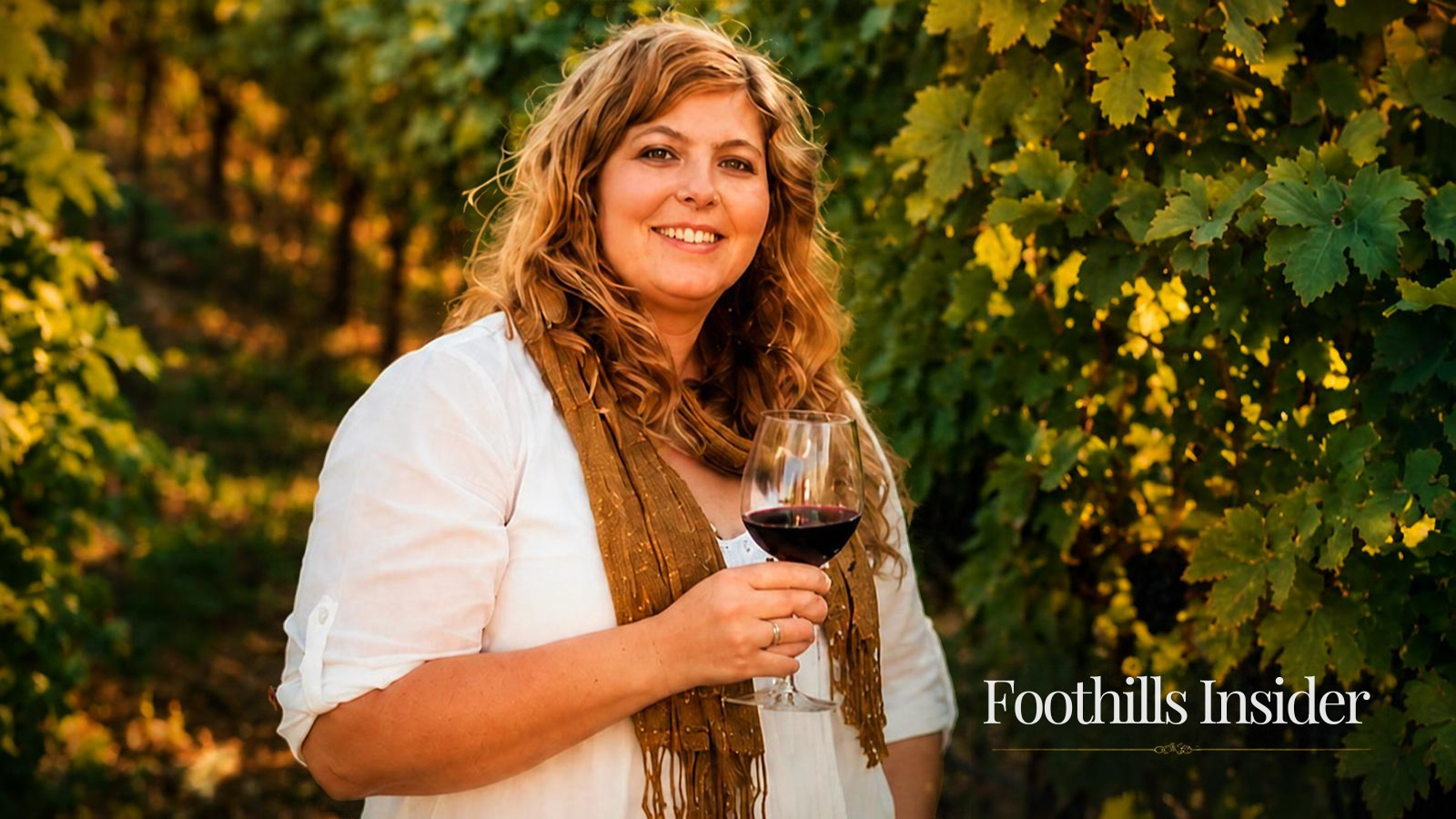
Jocelyn Maddux on the people, places and partnerships shaping Placer County. Wine. Agriculture. Tourism. Small business. Growth. Preservation. And the people who haven’t quite made it to the table yet.
“Sometimes the most interesting person in the room is the one who hasn’t been invited to the meeting yet.”
Since joining Auburn’s hospitality community in 2022, I’ve had the pleasure of watching Jocelyn’s work across Placer County—and I’ve been a little awestruck by the reach of it.
There are people who know a place by its roads, and there are people who know it by its relationships.
Jocelyn Maddux seems to know Placer County by both.
Her world moves between tasting rooms and boardrooms, agriculture and tourism, small businesses and conversations that take her all the way to Washington, D.C.
But what interested me most wasn’t how many rooms she has been in.
It was how often she talks about the people who aren’t there yet.
I wanted to know what someone with her unusually broad, dynamic view sees when she looks at the Placer County we are becoming—what we’re doing right, what we’re missing, what deserves protection and why collaboration matters much more than any one business, organization or community succeeding on its own.
And, naturally, I also needed to know what happens when nobody needs anything from her.
WHO’S NEXT?
Question: You seem to know everyone in Placer County. Who don’t you know—but think you probably should?
People say that to me all the time, and I always think, “You’d be surprised!”
I don’t have one particular name, but I’d really like to know more of the people who are quietly becoming the next Placer County—the younger farmers, entrepreneurs, chefs, makers, creatives and small business owners who may not be sitting at all the usual tables yet.
I’ve been around long enough that I know a lot of the established leaders, and that’s incredibly valuable. But sometimes the most interesting person in the room is the one who hasn’t been invited to the meeting yet.
I’m naturally curious about people anyway. If somebody is doing something interesting here that I don’t know about, I probably should know them. So introduce me.
Question: You grew up in the Bay Area. When did Placer County stop being where you lived and become your community?
It happened gradually, but I think the real turning point was when my work became rooted here. I spent eight and a half years working for a Placer County Supervisor, and that gave me an incredible education in the county—not just government, but the people, businesses, communities and issues that make this place what it is.
At some point I stopped thinking of myself as someone who had moved here and started feeling fiercely invested in what happens here. That’s probably when it became home.
WINE, WORK & THE BUSINESS OF DISCOVERY
Question: Your parents own a winery. Be truthful: does having winemakers in the family make holidays better, more complicated—or both?
Both. Absolutely both.
There is always good wine, which helps. But when your family owns a winery, wine is simultaneously the beverage, the family business and a recurring topic of conversation. There really isn’t an “off” switch.
Lone Buffalo Vineyards has been a huge part of my family’s life and has given us some wonderful experiences, friendships and memories. But family businesses are family businesses. Anyone who has one will understand exactly what I mean by that.
“We tend to discuss these things in separate rooms, but they aren’t separate issues.”
Question: You have a rare seat at a lot of different tables—wine, tourism, business, agriculture and community leadership. What do you hear at those tables that the rest of us aren’t hearing yet?
How interconnected everything actually is.
Agriculture needs tourism. Tourism needs small businesses and compelling experiences. Small businesses need infrastructure and sensible regulation. Local government needs a healthy economy. And all of them need housing, workers, water and transportation and so on.
We tend to discuss these things in separate rooms, but they aren’t separate issues.
I also hear a lot of conversation about how quickly Placer County is changing. Growth isn’t inherently bad—we need investment, housing and opportunity—but there is a very real question about how we grow without slowly eliminating the things that made people want to live here and visit here in the first place.
Question: You’ve helped convince thousands of people to grab a Placer Wine Trail Passport and explore local wineries and breweries over the years. What did you understand about people that made Sips & Suds work? And what idea did you try that absolutely did not?
I understood that people love a mission.
“Go visit some wineries and breweries” is vague. Give someone a passport, a map, stamps to collect, prizes to earn and places they haven’t discovered yet, and suddenly you’ve created an adventure. It taps into something I think is especially important here: discovery.
What I underestimated was just how competitive some people would become about those stamps.
Last year, I had a passport holder come into Lone Buffalo and essentially demand his stamps without tasting, purchasing or even staying to experience the winery. He had left his family waiting in the car. I wouldn’t give him the stamps. I explained that the whole point of the passport is to encourage people to actually experience these small businesses. If it becomes a race to run through the door and collect a stamp, we’ve undermined the very businesses the program is supposed to support.
He was extremely unhappy with me and proceeded to let Yelp and pretty much every social media channel know about it!
It was upsetting at the time, but also instructive. This year I changed the rules to make the intent explicit and prevent that from happening. That’s one thing I’ve learned about events: people will inevitably find the loophole you didn’t know existed.
Question: Forget the official tourism pitch. A friend has never been to Placer County and gives you exactly 24 hours. Where are you taking them—and what are you feeding them?
First, a disclaimer: I’m choosing Auburn and the surrounding area because it’s my hometown and the part of Placer County I know most intimately—not because I think this is the only great 24 hours you can have here. I could build completely different 24-hour itineraries for different parts of Placer County and fill every one of them with great experiences and adventures.
But for my 24 hours, we’d start with breakfast or coffee at Pour Choice or The Baker & The Cakemaker in Auburn, or North Fork Chai in Newcastle.
Then I’d get them outside. Depending on the weather and how ambitious we were feeling, that might mean a hike around the Confluence or Hidden Falls, or heading farther up toward Colfax. Part of understanding Placer County is seeing how quickly you can go from town to some pretty spectacular scenery.
For lunch, we might grab sandwiches from Newcastle Cheese Shop and head into wine country, or make Lecavalier Cellars both our wine tasting and lunch stop.
Then I’d call ahead to some wineries—not simply to arrange tastings, but to find out where the owner or winemaker will actually be. That’s the experience I want my friend to have. Lone Buffalo, of course, and then someplace like PaZa, Vina Castellano, Casque, Dora Dain or Wise Villa. I want them talking to the people who grow the grapes, make the wine and built these businesses. That’s one of the things that still makes wine tasting here so special.
If I could squeeze in a brewery, it would be Moonraker or Moksa. Both make exceptional beer across a really diverse range of styles and have great taproom vibes. And there’s a very good chance an unscheduled beer or cider at The Station Public House would somehow work its way into the day.
Dinner would unquestionably be Restaurant Josephine in Auburn. The chef-owners are there, they’ll probably come out and say hello, and to me they are one of the truest expressions of farm-to-fork seasonality we have. The food is elevated without the experience ever feeling overly precious or snobby, and the creativity and quality are unmatched.
Would we actually accomplish all of this in 24 hours? Probably not. But we’d have fun trying.
And then ask me for another 24 hours and I’ll take you somewhere completely different in Placer County.

Question: You’re a foodie and you know wine. What’s one pairing you love that would make a wine snob raise an eyebrow?
“Potato chips, caviar and bubbles.”
It’s the perfect highbrow/lowbrow combination—and it’s actually a fantastic pairing. Salty, fatty potato chips, briny caviar and cold sparkling wine. Give me that over an overly serious wine-and-food pairing any day.
CONNECTING THE DOTS
Question: What’s something Placer County does exceptionally well that we don’t give ourselves enough credit for? And what’s something we need to get much better at?
We create extraordinarily good things without always realizing how extraordinary they are.
Wine, beer, mandarins, produce, restaurants, recreation, arts, small businesses—we have an incredible concentration of people growing, making and creating things here. And because we’re not overly polished as a destination, visitors can still have authentic experiences and actually meet the people behind them.
What we need to get much better at is connecting the dots.
We still market ourselves too often as individual businesses, individual communities and individual sectors. Visitors don’t care about jurisdictional boundaries or organizational charts. They want a great experience. We need to make it easier for them to understand everything that’s here and move between those experiences.
Question: You’ve gone from local conversations in tasting rooms and boardrooms to conversations in Washington, D.C. What becomes surprisingly clear about Placer County when you’re 2,500 miles away talking about home?
How unusual Placer County really is.
We stretch from the Sacramento Valley through agricultural foothills and historic communities all the way to Lake Tahoe. We have rapidly growing suburban communities alongside farms, ranches, vineyards and places that still feel remarkably rural.
When you’re here every day, those contrasts become normal. When you’re 2,500 miles away trying to explain Placer County to someone else, you suddenly realize how unusual—and valuable—that combination is.
It also becomes very clear that if we want state and federal decision-makers to understand places like ours, we have to tell the story ourselves. Nobody in Washington is going to intuitively understand the nuances of Placer County agriculture, tourism or small business unless someone brings those stories to them.
Question: You’ve watched wineries, breweries, restaurants, farms, hotels and small businesses try to attract the same visitor. When does competition become collaboration—and does Placer County truly understand that yet?
Competition becomes collaboration the moment we understand that none of us is really the destination by ourselves.
A visitor isn’t coming to Placer County because of one winery, one restaurant, one hotel or one brewery. They’re deciding whether the whole experience is worth the trip.
That means my success can actually depend on your success. A great hotel keeps someone overnight. A great restaurant keeps them in town for dinner. A winery gives them something memorable to do that afternoon. A brewery gives them another experience to add to the trip. Suddenly a two-hour visit becomes a weekend.
Do we completely understand that yet? No. But we’re getting better at it—and I think the businesses and organizations that understand it first will be the ones that benefit most.
“A visitor isn’t coming to Placer County because of one winery, one restaurant, one hotel or one brewery. They’re deciding whether the whole experience is worth the trip.”
WHAT WE PROTECT NEXT
Question: Twenty years from now, what do you hope we protected before growth had the opportunity to change it? And what do you hope we were brave enough to change?
I hope we protected our agricultural land, our open space, our historic communities and some of the wonderfully quirky character that still exists here.
Agriculture is especially important to me because once farmland is developed, we’re not getting it back. Preserving agriculture doesn’t mean freezing Placer County in time. It means making sure agriculture is economically viable enough that the next generation has a reason to keep farming.
What do I hope we were brave enough to change? The idea that growth and preservation are automatically opposing forces.
Good planning should allow us to accommodate housing, jobs and economic opportunity while being much more intentional about where growth belongs—and where it doesn’t.
Question: What effort are you involved in that you would like highlighted in this interview?
The work I’m most interested in right now doesn’t fit neatly under one organization—and that’s probably the point.
I’m involved in wine, agriculture, tourism, publishing, business and community leadership, and increasingly I see those as parts of the same conversation. How do we keep agriculture economically viable? How does tourism support our farms, wineries, breweries, restaurants, hotels and other small businesses? How do we regulate thoughtfully without making those businesses impossible to operate? How do we accommodate growth while protecting the landscape and character that make Placer County worth visiting—and worth living in?
There are important efforts underway around agritourism, agricultural planning and destination development that are beginning to connect those dots.
That’s probably the work that excites me most: getting people who don’t traditionally sit at the same table into the same conversation. Because I think Placer County’s future depends less on any one industry succeeding and more on understanding how much we all depend on one another.
OFF THE CLOCK
Question: Last one. No job titles, boards, committees or organizations allowed: Who is Jocelyn Maddux when nobody needs anything from her?
First, I need to know where this mythical place is where nobody needs anything from me. I’m pretty sure I have to get at least 100 miles away from Placer County before that happens.
When I actually am off-duty, I’m much less complicated than my calendar makes me look. Give me a small group of good friends and almost any excuse to go somewhere, and I’m happy. That often still involves visiting a winery or brewery, finding a great restaurant, trying someplace new or returning to one of my favorite places around the region.
And then there’s shopping.
I have a somewhat unchecked shopping habit and am constantly curating my closet for both work and play. Apparently, when I’m not organizing events, promoting businesses or trying to solve community problems, I’m organizing outfits.
So maybe the short answer is: good friends, good food, good wine, a little adventure—and probably a new pair of shoes I can absolutely justify.

Perhaps that’s what makes people like Jocelyn interesting.
Not simply the number of tables they have a seat at—but whether they notice who isn’t sitting there yet.
Placer County is changing. It will continue to change.
The more interesting question may be whether we can connect its farms, towns, businesses, restaurants, wineries, hotels, makers, entrepreneurs and next generation of leaders well enough to grow without sanding away all the things that made this place remarkable to begin with.
And perhaps the next person who helps us figure that out hasn’t been invited to the meeting yet.
So let’s invite them.
YOUR TURN
Who is quietly helping shape Placer County—and deserves a seat at the table? Submit your article or request by clicking the collaborate link.